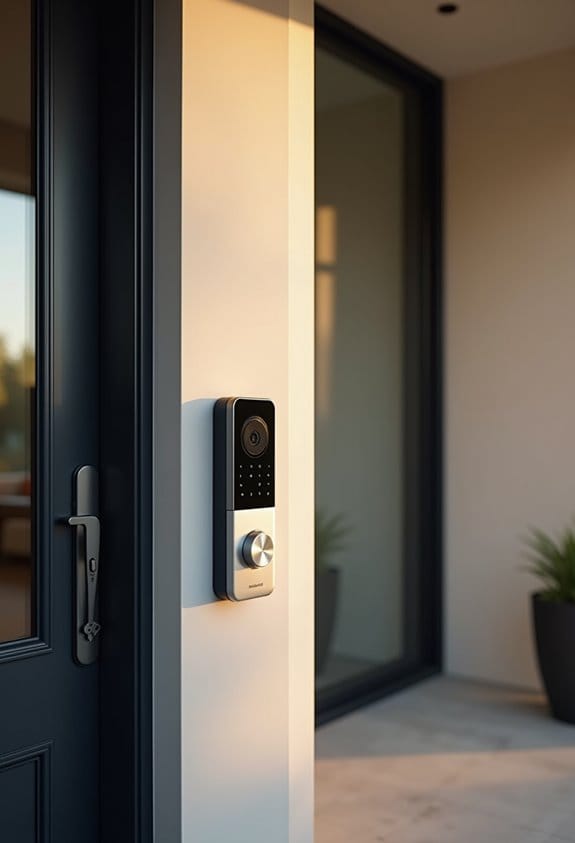
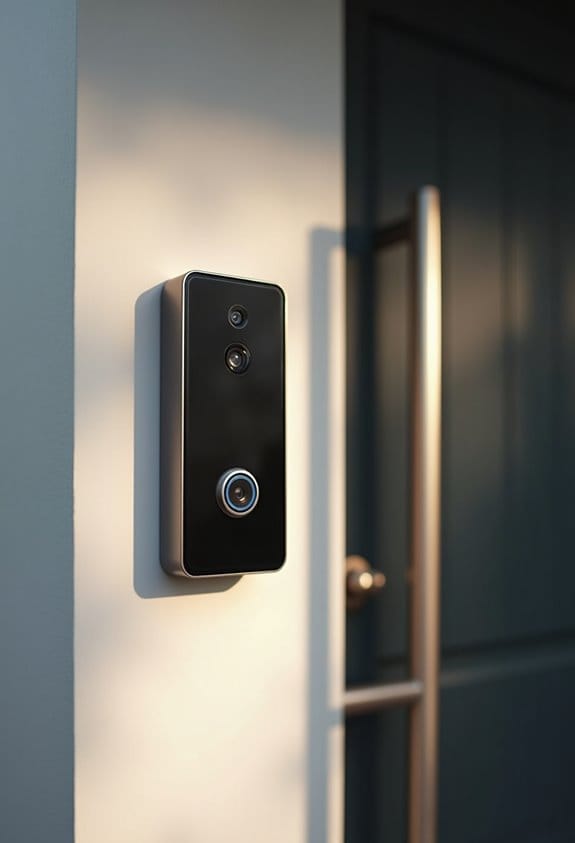
Doorbell AI features improve security by identifying people, packages, and vehicles using advanced algorithms, like Convolutional Neural Networks. They can minimize false alerts, but misidentifications can still happen due to factors like lighting or obstructions. For example, shadows might be mistaken for a person, or animals could trigger alerts. To optimize effectiveness, we suggest adjusting settings, creating activity zones, and prioritizing models with 1080p video quality. There’s much more to explore about how these systems can protect our homes effectively.
Key Takeaways
- Doorbell AI uses advanced algorithms and CNNs to accurately identify events involving people, packages, and vehicles, reducing false alerts significantly.
- Limitations include potential misidentifications due to poor lighting, obstructions, and complex scenes with multiple moving objects.
- Privacy concerns arise with facial recognition technology, as unauthorized access and surveillance without consent pose significant risks.
- Customizable notification settings help users focus on critical alerts, avoiding overwhelming notifications from non-important movements.
- Cloud storage reliance can compromise privacy, making encryption and understanding data management policies essential for securing video footage.
What Are Doorbell AI Features and How Do They Work?

Doorbell AI features represent a significant advancement in home security technology. These AI features leverage sophisticated algorithms that enhance motion detection, enabling reliable person detection compared to traditional systems. Utilizing Convolutional Neural Networks (CNNs), the doorbell analyzes video data, recognizing shapes and colors. This process allows for accurate identification of events outside our homes, minimizing false alerts. For instance, we receive notifications when a package arrives, or when a vehicle parks in our driveway. By training on extensive datasets, the AI improves its understanding of human appearances and actions. This results in timely alerts that help us make informed security decisions. Overall, these advancements mean simplified and effective home monitoring without constant interaction or manual oversight. Many models also offer customizable alert settings to provide tailored security coverage based on user preferences.
How Do AI Features Differentiate Between People, Packages, and Vehicles?

Understanding how AI features differentiate between people, packages, and vehicles can greatly enhance our security experience. AI technology in our doorbell security cameras uses advanced algorithms to analyze video data and identify distinct shapes, colors, and movement patterns. For instance, when detecting people, it focuses on human body shapes and movements, while package recognition involves identifying typical box-like structures. Vehicles are recognized by their distinct dimensions and shapes. This AI processing generates relevant AI alerts, ensuring we are aware if it’s a delivery person rather than a stray animal, considerably reducing false positives. Ongoing updates to these algorithms improve detection by incorporating user feedback, adapting to new package designs or vehicle models, thereby enhancing reliability over time. Key to minimizing unnecessary alerts is the use of AI-powered alerts that specifically detect human motion to improve notification accuracy.
Understanding the Limitations of AI Person Detection

While AI person detection systems have come a long way in enhancing security, they’re not without their limitations. These systems use Convolutional Neural Networks (CNNs) to identify humans by analyzing shapes and colors. However, factors like poor lighting or obstructions can lead to misidentifications. Without diverse training datasets, AI may struggle to accurately recognize different human appearances and activities. While AI can reduce false alarms compared to older methods, performance can vary considerably between models, highlighting the need for regular updates to maintain accuracy. Additionally, we should remember that even the best AI person detection systems can produce occasional errors, especially in complex scenes with multiple moving objects. Staying informed is key to effective use of our security system. Many advanced doorbell cameras now incorporate smart AI human detection to improve the precision of motion alerts and reduce false alarms.
Common Misidentifications by AI in Doorbell Cameras
Misidentifications by AI systems in doorbell cameras can result in frequent false alerts, which can be frustrating for homeowners. Common misidentifications often include tree branches, shadows, or passing vehicles incorrectly labeled as people. AI models may struggle in challenging lighting conditions, particularly in low-light or highly contrasted environments. Frequently, we receive alerts for animals, like pets or wildlife, mistaken for humans—distracting us from real security concerns. The training data used to develop AI models may not encompass all scenarios, limiting their accuracy. User feedback plays a crucial role in enhancing AI performance. By identifying false positives, we can help refine algorithms, improving person detection and overall security effectiveness in doorbell cameras. Choosing doorbell mounts made from UV-stable materials can also reduce false alarms caused by adverse weather conditions, contributing to reliable AI detection.
What Factors Can Impact AI Performance With Your Doorbell?
Several factors can influence the performance of AI in our doorbell cameras, making it essential for us to evaluate them for ideal operation. Lighting conditions, such as low light or bright sunlight, can affect how well the AI camera detects objects. Weather, including rain or snow, may obscure visibility. Also, the stability of our Wi-Fi network is vital—slow connections can delay notifications. Obstructions, like plants or furniture, limit the camera’s field of view, hindering detection. The quality of the AI algorithm matters too; diverse training data helps the camera detect persons, packages, or vehicles more accurately. Finally, edge processing enhances speed and privacy, while cloud processing may improve detection but comes with latency issues. Additionally, features like advanced motion detection significantly reduce false alarms and improve the reliability of AI alerts.
How Does Machine Learning Enhance Doorbell AI Accuracy Over Time?
As we explore how machine learning enhances the accuracy of doorbell AI over time, it’s important to recognize that these systems constantly improve by learning from data. Machine learning utilizes large, labeled datasets to train the artificial intelligence behind video doorbells, helping them identify various human features and actions. By using Convolutional Neural Networks (CNNs), these AIs break down visual inputs, leading to precise detection of people, packages, and vehicles, even under challenging conditions. The predict-and-correct methodology allows algorithms to be refined based on real-world performance, increasing alert reliability. Additionally, feedback from users helps AI models adapt to unique environments, ensuring ongoing accuracy improvements as they encounter new scenarios and data over time. Modern doorbell cameras often leverage AI Human Detection to reduce false alerts and enhance security effectiveness.
Debunking Common Misconceptions About Doorbell AI
Understanding doorbell AI can be challenging, especially with the array of myths surrounding its capabilities. Many people think it can recognize every moving object seamlessly; however, AI works primarily to identify people versus inanimate objects, reducing false alerts. Some believe all doorbell cameras perform equally well in the dark, but performance depends on specific algorithms and technologies, like infrared. It’s also a common misconception that AI features need no updates; calibration and software improvements are essential for accuracy over time. While familiar faces can improve recognition, don’t expect AI to eliminate all false alerts, especially in crowded areas. Understanding these limitations is key to using doorbell AI effectively as a new security measure. Additionally, the AI-powered motion tracking technology helps ensure that no movement goes unnoticed, enhancing overall security.
Understanding Privacy Risks With Ai-Powered Doorbells
How safe is our privacy when using AI-powered doorbells? The integration of these devices into our smart home raises significant privacy risks, particularly due to facial recognition technology. We’ve seen incidents where unauthorized access to video data occurred, leading to major fines, like Amazon’s $5.8 million penalty. Activists from organizations like the Electronic Frontier Foundation highlight how facial recognition may track individuals without consent, infringing on privacy rights. In response, states like Illinois and Texas have placed regulations on this technology. While companies claim that facial data is encrypted and not used for training models, questions remain about the effectiveness of these measures. We must remain vigilant regarding our privacy as we embrace these advanced security tools. Additionally, it is important to consider that many AI-powered doorbells rely on cloud storage plans, which can introduce further privacy and security concerns.
Optimize Your Doorbell Alert Settings for Better Customization
Have you ever felt overwhelmed by constant notifications from your doorbell? To optimize your alert settings, we can customize notifications to focus on specific events, like people, packages, or vehicles, minimizing distractions. Most doorbell models let us create activity zones, which define areas that need monitoring and ignore irrelevant background movements. Additionally, enabling familiar face detection helps us receive personalized alerts when recognized individuals approach our door. Adjusting sensitivity settings for motion detection can further fine-tune our alerts, reducing false positives from passing vehicles or animals. Finally, scheduling notifications during inactive hours offers tranquility while ensuring we don’t miss critical updates when it matters. By implementing these strategies, we can enhance our overall user experience considerably.
Best Practices for Choosing a Video Doorbell With AI Capabilities
Choosing the right video doorbell, especially one with AI capabilities, can greatly enhance your home security. First, we should prioritize models that offer at least 1080p HD video quality and a wide field of view of at least 120 degrees. This assures clarity in identifying visitors. Next, look for doorbells equipped with advanced AI algorithms that can accurately detect people, packages, and vehicles, helping to minimize false alerts. Customizable alert settings are essential—they allow us to filter notifications by recognized faces or suspicious activities. Additionally, consider models with integrated night vision for effective low-light performance. Finally, check for an IP rating above 65 to confirm weather resistance and durability, guaranteeing peak operation in varying conditions. It is also important to consider secure cloud storage options that use encryption to protect your video footage.
Frequently Asked Questions
What Are the AI Features of the Ring Doorbell?
The Ring doorbell capabilities include AI detection accuracy for identifying people, packages, and vehicles. With smart home integration, it personalizes alerts, enhancing our security experience and reducing unnecessary notifications for a more efficient monitoring system.
Is There a Monthly Fee for the Ring Doorbell?
Yes, there’s a monthly fee for the Ring doorbell. With Ring subscription options, we gain smart home integration and enhanced features, making the doorbell a cost-effective choice for improving our home security and convenience.
Why Is the Ring Doorbell Discontinued?
The Ring Doorbell’s been discontinued due to declining product performance—over 60% of users wanted better detection. We’re also seeing heightened competition and user privacy concerns, prompting the shift to newer models with advanced technology.
Does the Ring Doorbell Detect Vehicles?
The Ring Doorbell doesn’t reliably detect vehicles; its vehicle detection limitations mean we’ll only get car alert notifications when it senses motion. It’s better suited for monitoring driveways with an emphasis on person detection.