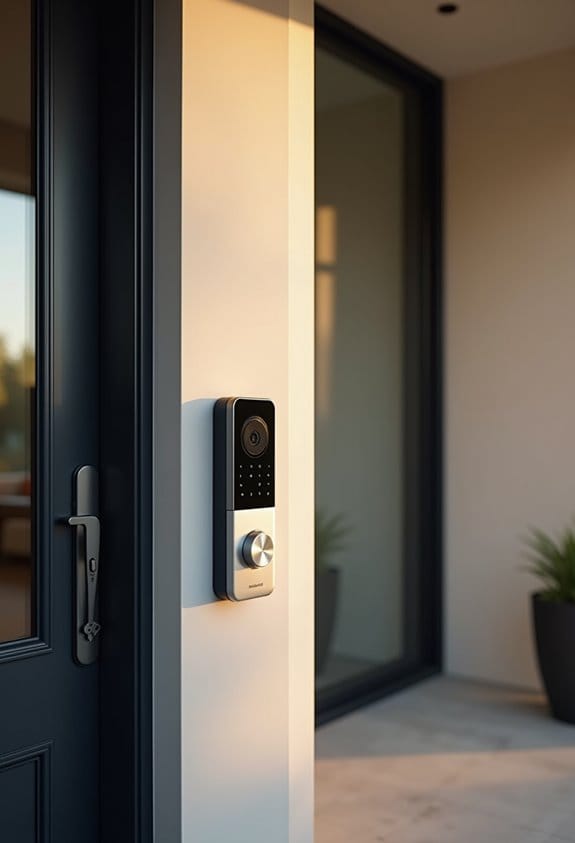
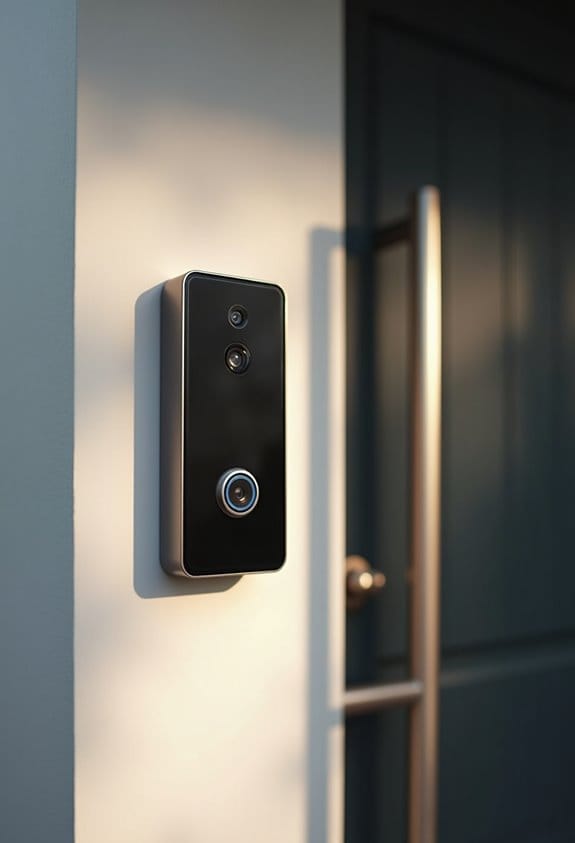
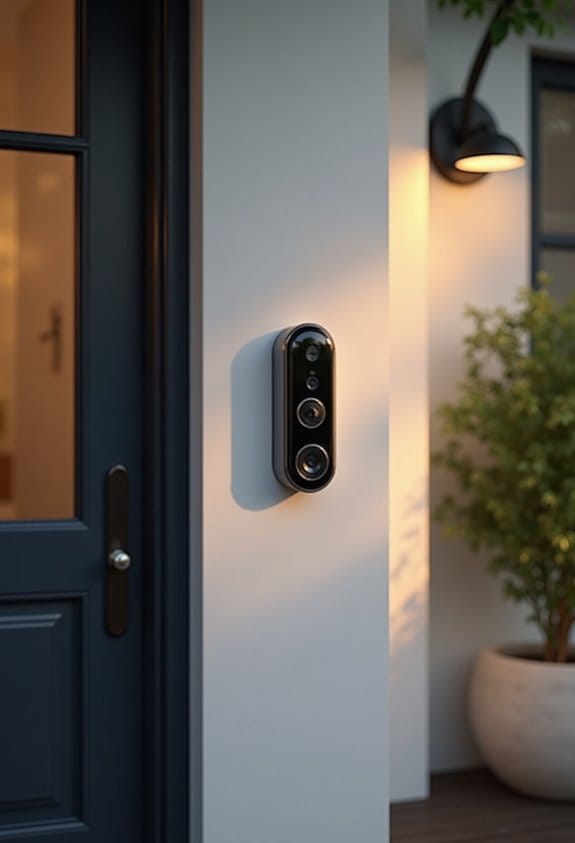
Doorbell motion detection uses two main technologies: Passive Infrared (PIR) sensors and pixel-based detection. PIR sensors detect heat changes from moving objects, effectively sensing people and pets within 7 to 30 feet. Conversely, pixel-based systems analyze video frames for pixel differences, but can be triggered by non-human movements. To maximize performance, consider mounting height and environmental factors like sunlight. If you stay with us, you’ll discover effective solutions for common detection issues and best installation practices.
Key Takeaways
- PIR sensors detect motion by sensing changes in infrared radiation from warm bodies, while pixel-based technology analyzes video frame changes.
- PIR sensors have a range of 7 to 30 feet and are less likely to produce false alerts compared to pixel-based systems.
- Pixel-based systems can yield false positives due to environmental factors like lighting and are typically energy-intensive due to continuous recording.
- Adjustments such as sensitivity settings and motion zones can improve detection accuracy and reduce false alerts for both PIR and pixel-based technologies.
- Proper installation, including height and position, significantly enhances the effectiveness of both motion detection methods in video doorbells.
Understanding PIR Sensors: Basics of Motion Detection

Understanding the technology behind Passive Infrared Sensors, or PIR sensors, is crucial for grasping how motion detection works in modern doorbells. PIR sensors detect motion by sensing changes in infrared radiation emitted by warm-blooded creatures. This means they activate alerts when specific heat signatures shift within their field of view. Effective in ranges of 7 to 19 feet, they can respond to movement up to 30 feet away. By focusing on heat rather than light, they minimize false alerts caused by non-living factors like shadows or wind. Additionally, sensitivity settings enable us to adjust the sensor’s detection levels based on the environment. This customization guarantees PIR sensors provide accurate motion detection, especially in low-light situations. Many doorbell cameras further enhance accuracy by using AI motion detection to reduce false alarms from pets and environmental factors.
How Pixel-Based Detection Works in Doorbells

Pixel-based motion detection in doorbells offers a modern approach to monitoring movement through visual analysis. This technology analyzes sequential video frames to identify changes in pixel arrangement. When significant differences are detected, the system triggers alerts. Users can adjust sensitivity settings within the app, tailoring the number of pixels analyzed to minimize false alarms. This method is fast and energy-efficient, functioning ideally for larger areas. However, it can yield false positives from environmental factors, like lighting changes. To enhance accuracy, pixel-based motion detection often works alongside PIR technology. It’s worth noting that while it can detect motion through glass, placement is essential for peak performance in your security system. Utilizing motion zones can also improve detection effectiveness. Many doorbell cameras now include customizable motion zones to reduce unnecessary alerts and focus on true motion events.
Comparing Effectiveness: PIR vs Pixel-Based Motion Detection

When we compare Passive Infrared (PIR) and pixel-based motion detection technologies, we find distinct advantages and challenges associated with each method. PIR sensors excel at identifying human presence by detecting heat signatures within a range of 20 to 30 feet. They’re less prone to false alerts triggered by environmental factors, like shadows or light changes. In contrast, pixel-based systems analyze frame-by-frame changes, leading to more frequent false positives from non-human movements, such as trees swaying in the wind. Additionally, PIR technology is energy-efficient and conserves storage, recording only when heat is detected, whereas pixel-based systems often consume more energy and storage due to continuous recording from any pixel difference, making PIR the more reliable choice for motion detection. Many advanced doorbell cameras now implement AI Human Detection to further reduce false alerts and improve accuracy.
Common Applications of PIR Technology in Doorbells
PIR technology finds numerous applications in doorbells, primarily centered around enhancing home security and user convenience. These sensors detect body heat emitted by warm-blooded creatures, activating alerts within a 30-foot range. This capability minimizes false alerts caused by non-living factors, making PIR doorbells reliable in outdoor settings. When installed, they markedly improve home security by identifying visitors and potential intruders effectively. Additionally, many modern doorbells integrate low-light performance, ensuring motion detection even in darkness, when most unauthorized activity occurs. The quick response time of PIR technology also activates recording features, capturing essential movements for later review. Consequently, PIR technology in doorbells offers a robust solution for enhancing safety and monitoring our homes. Many Arlo doorbells also utilize real-time motion alerts to keep homeowners promptly informed of detected activity.
Managing Environmental Factors for Better Motion Detection
To guarantee ideal motion detection performance, we must carefully consider various environmental factors that can interfere with our doorbell systems. Direct sunlight can create glare on the lens, which negatively impacts the efficiency of both Passive Infrared (PIR) sensors and pixel-based systems. Windy conditions might cause branches or leaves to sway, triggering unnecessary alerts in pixel technology. Additionally, temperature fluctuations can affect PIR sensors, as they depend on detecting heat signatures. To reduce false alerts, we should position our doorbell away from temperature-retaining plants or heat sources. Finally, ensuring our camera is mounted steadily on a stable structure minimizes movement, which boosts the accuracy of motion detection, leading to a better security experience overall. Utilizing customizable detection zones can further minimize unwanted alerts and increase detection accuracy.
How to Set Up Motion Zones for Better Alerts
Setting up motion zones can greatly improve the effectiveness of our doorbell cameras. By defining specific areas, we can focus alerts where they matter most. Most cameras allow us to establish 3 to 5 customizable motion detection zones, targeting spots like doorways or driveways while filtering out irrelevant movements, such as passing cars. Advanced cameras even offer polygonal zone customization for irregular property boundaries, enhancing monitoring accuracy. To set up these zones, we can access the motion detection settings via the app. Using the live feed as a canvas, we draw shapes directly on the camera view. This not only conserves battery life in wire-free models but also saves storage space, optimizing our security experience. Customizable motion detection zones let us prioritize activity zones for more relevant alerts and less false notifications.
Solutions to Common Motion Detection Issues
Frequently, homeowners encounter issues with motion detection on their doorbell cameras. To improve performance, adjusting the motion sensitivity for both PIR motion and pixel-based detection systems is vital. This helps reduce unwanted motion alerts triggered by shadows or temperature changes. Implementing motion zones lets us specify areas of interest, leading to more accurate notifications and fewer distractions. Regular maintenance, like cleaning the camera lens and ensuring proper camera alignment, can greatly enhance performance. Additionally, utilizing AI enhancements allows intelligent filtering of alerts, distinguishing between people, animals, and objects. This technology plays an essential role in reducing false alerts, helping us feel more secure about our home monitoring systems. Choosing a doorbell camera with AI human detection significantly minimizes false alarms and improves security.
How Activity and Privacy Zones Boost Your Security
While enhancing our home security, understanding how to set up activity and privacy zones on our doorbell cameras can greatly improve the effectiveness of our monitoring systems. Customizable activity zones allow us to designate specific areas to monitor, filtering out irrelevant motion. This feature helps minimize false notifications from passing cars or pedestrians, making our alerts more relevant. Privacy zones, on the other hand, let us exclude areas that shouldn’t be recorded, ensuring sensitive spaces remain protected. Many advanced systems offer polygonal motion zones for precise control. By focusing on defined boundaries, we not only enhance motion detection but also save battery life and storage space, capturing only the necessary events. This straightforward setup considerably boosts our security.
Best Practices for Installing Your Video Doorbell
Installing a video doorbell can considerably enhance our home security, but achieving the finest results requires careful attention to how and where we mount the device. For ideal motion detection, we should ideally place the camera at a height of 4.5 to 5 feet. Avoid locations with direct sunlight or extreme temperatures since this can affect camera performance. It’s essential to secure the video doorbell to a stable structure and steer clear of windy areas to minimize false triggers. We can further customize motion zones to focus on important detection areas, like pathways, while ignoring irrelevant motion. Additionally, we need to regularly adjust motion sensitivity settings through the app to balance alerts and avoid overload from minor movements. Selecting doorbells with advanced motion detection technology can further reduce false notifications and improve overall security effectiveness.
Summary of Motion Detection Technologies: What to Remember
Video doorbells today primarily rely on two sophisticated motion detection technologies: Passive Infrared (PIR) sensors and pixel-based detection methods. PIR technology helps us detect human presence effectively within a range of 7 to 19 feet, minimizing false alerts from non-living sources like passing cars. Conversely, pixel-based detection analyzes changes between video frames, which can lead to more false positives as it reacts to various environmental factors. Users can enhance their experience by customizing motion detection zones within the camera’s field of view, targeting specific areas for alerts. Understanding these technologies helps us improve installation and monitoring efficiency, ensuring our security cameras work efficiently while reducing unnecessary notifications and maximizing peace of mind.
Frequently Asked Questions
Which Is Better, PIR or Motion Detection?
Like a dance between shadows and light, we find each method has its rhythm. PIR’s energy efficiency and fewer false alerts often win, while pixel technology offers broader detection—both serve home security, but preferences guide our choices.
What Is PIR Vs Pixel?
PIR sensors excel in energy efficiency and low-light conditions, relying on heat detection. Meanwhile, pixel-based sensors analyze video frame changes. We should consider their installation differences, preferred applications, and environmental factors for ideal user experience.
What Are the Disadvantages of PIR Sensors?
Like a cautious friend, PIR sensors can lead to false alarms due to environmental factors. Their limited coverage, detection range, temperature sensitivity, and installation challenges often leave us facing weather interference and power consumption concerns.
How Does PIR Motion Detection Work?
PIR sensor functionality relies on infrared technology to detect warm bodies, providing motion detection accuracy while being energy efficient. While installation requirements are minimal, environmental factors influence triggering mechanisms, highlighting the advantages of PIR in various settings.